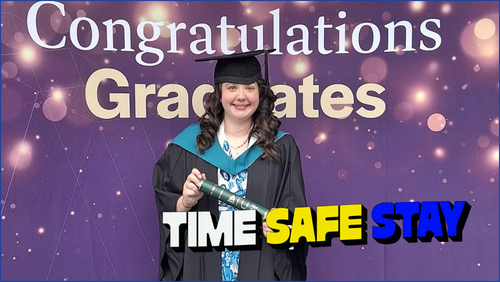
To help raise awareness of epilepsy for International Epilepsy Day 2026, Rachael has reflected on her experiences of living with epilepsy…
My journey with epilepsy began in 2009, when I had my first seizure at the age of fifteen. Later that year, following my first EEG in Crumlin Children’s Hospital, I was diagnosed. At the time, I didn’t fully understand what epilepsy was or how much it would affect my life. I didn’t cry when I was diagnosed — not because I wasn’t scared, but because I didn’t yet know what epilepsy truly meant. My mother cried for me, because she understood what I could not yet comprehend.
As the years went on, it became clear that my epilepsy was complex. I live with both generalised and focal epilepsy and experience several different types of seizures. Epilepsy is not one condition — it is many — and it affects everyone differently.
My seizures were difficult to control, and I was later diagnosed with drug-resistant epilepsy. Over the years, I tried many different treatment approaches in the hope of finding stability. This included various treatment, along with numerous investigations and procedures, but unfortunately none provided long-term seizure control.
I continued to pursue education wherever possible, even while living with uncontrolled epilepsy. During this time, I completed several further education qualifications, including QQI Level 5 and Level 6 certifications in Maternity Care Assistance, a separate qualification in Nursing Studies, and another in Youth and Community Development. Education gave me purpose during a period when my health often made life unpredictable, and it reminded me that epilepsy had not taken away my ability to grow or contribute.
In 2020, as my seizures continued to worsen, I had a vagal nerve stimulator (VNS) implanted in my chest to help with seizure management. While it did not bring the level of control I had hoped for, it was another step in my determination to keep moving forward.
During the COVID-19 pandemic, my seizures became increasingly difficult to manage. Access to specialist services was limited, and my condition deteriorated significantly. I later underwent extensive internal and external monitoring to determine where my seizures were originating from and to assess whether surgery was an option.
In April 2022, I underwent brain surgery. Recovery was challenging, but the surgery gave me something I had not experienced in years — stability. Following this, I experienced two years and two months of seizure freedom, which allowed me to begin rebuilding my independence and confidence.
In September 2022, I began my degree in Pharmaceutical Science with Drug Development at Atlantic Technological University, Sligo. I successfully completed the first two and a half years of the programme, something I was incredibly proud of.
In June 2024, I experienced a breakthrough seizure. This was a frightening and difficult time, particularly after such a long period of seizure freedom. However, rather than allowing this setback to define me, it strengthened my determination.
In September 2024, I returned to college to begin the final year of my degree. I was more driven than ever — determined to prove to myself that epilepsy was not going to stop me from achieving my goals.
Despite ongoing challenges, I completed my degree in Pharmaceutical Science with Drug Development and graduated in October 2025. Later that year, I successfully completed a Quality Co-Op Internship within a pharmaceutical company in December 2025. This experience, along with my academic achievements, further enhanced my practical knowledge, strengthened my professional skills, and deepened my confidence in pursuing my chosen career path in the pharmaceutical industry.
Living with epilepsy has brought many challenges beyond seizures alone. One of the most difficult has been judgement and misunderstanding. Many people still hold outdated beliefs about epilepsy, highlighting the importance of education and awareness.
Anyone can witness a seizure at any time, and knowing correct seizure first aid and the key words of TIME, SAFE, STAY can save lives. This is why I choose to speak openly about my epilepsy — awareness protects people and helps reduce stigma.
My experience of epilepsy healthcare in Ireland has shown me how dedicated medical teams are, but also how limited specialist resources can be. This is not a reflection of healthcare professionals, but of the system itself.
Epilepsy Ireland has been a vital source of support throughout my journey. Through their services, I learned my rights, gained access to education, and felt empowered rather than isolated.
Epilepsy is one of the most costly things I have ever lived with — emotionally, physically, mentally, and financially.
But I have also learned that some things are worth the price.
Despite everything, I earned my degree, continued my education, and proved to myself that epilepsy does not define my limits.
Epilepsy is part of my life, but it does not define who I am.
By sharing my story, I hope to raise awareness, challenge stigma, and remind others living with epilepsy — especially those newly diagnosed — that they are not alone.
Thank you, Rachael, for sharing your story as part of our awareness campaign for International Epilepsy Day 2026.
Further Information
- To see and listen to our new campaign for #EpilepsyDay 2026, visit the 'International Epilepsy Day 2026' page on our website
- To learn more about Epilepsy, visit the ‘Epilepsy Information’ page on our website.
- For more information epilepsy surgery visit the 'Epilepsy Surgery' page of our website
- Should you need any information or support about your or your loved one's epilepsy, please do not hesitate to contact your local Community Resource Officer. You can find their details by visiting the ‘Our Local Service’ page on our website.