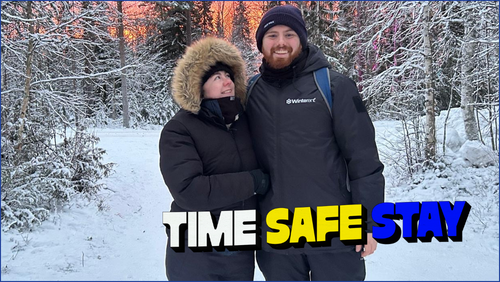
Last year on Virgin Media, the incredible Brain Doctors aired. One of the stories featured was that of longstanding Epilepsy Ireland Media Volunteer, Katie Cooke. Katie has reflected on her life with epilepsy to help raise awareness for this year’s Epilepsy Day and you can also watch the part of her surgery journey featured on the Brain Doctors last year…
I was diagnosed with epilepsy when I was nine years old. At first, it was chaotic but manageable, the kind of condition that causes disruption, but hadn’t yet hijacked my life. That didn’t last.
Things changed rapidly when I entered my teens. Epilepsy well and truly decided to make itself the main character. I began having around ten seizures a day, which was triggered by medication changes. At the time the solution seemed simple: bring me into hospital and raise my medication levels intravenously. The result was anything but simple! I became practically comatose for days after the treatment.
The doctors weren’t sure what was happening. What followed was a year of escalating seizures, prolonged status epilepticus and severe side effects to Anti-Seizure Medications. I walked into Crumlin Hospital on my own two feet and following a barrage of treatment across the course of a year, I left in a wheelchair with seizures that no longer seemed interested in stopping. On a “good” day, I had about ten seizures. On a bad day, thirty wasn’t unusual. It was exhausting, unpredictable, and relentless, the kind of condition that doesn’t let you forget it exists, even for an hour.
When I was sixteen, I met my adult neurologist for the first time. I genuinely believe this man was an angel sent from heaven, or at the very least, neurology’s best attempt at one. He listened to me. More importantly, he was honest. If he didn’t know what was going on, he said so. That kind of honesty is rare in medicine, and I trusted him completely. Unfortunately, honesty doesn’t stop things from getting worse, and they did.
When I was 18, I remember telling him how I loved running – but how I was always barred from competing due to the severity of my seizures. He mentioned that the Hospital were looking for runners for the marathon. I don’t think either of us truly believed I’d run it but we decided to try anyway. As he was also a runner, he agreed to train and run with me - and because he was a neurologist, race officials couldn’t exactly argue if he deemed me fit to continue!
We ran our first marathon in four hours and twelve minutes. I had seven seizures along the way. It still remains one of the proudest days of my life. Naturally, I decided we should do it again!
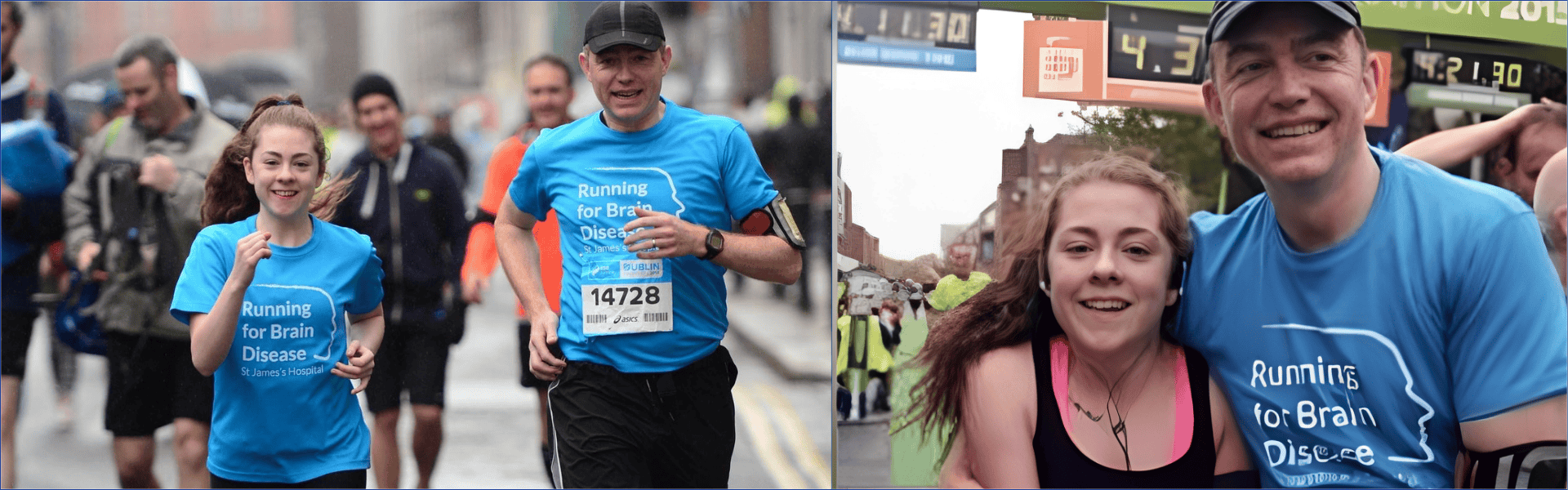
After my second marathon, things began to deteriorate. I started off at having ten seizures a day, that number slowly crept up to fifteen, then twenty. I was admitted to hospital for a different approach to my treatment. However, nothing was working,
For weeks, every time I fell asleep, I went straight into status – and it felt like a world supply of emergency meds wouldn’t stop it. Eventually, the decision was made to put me into a medically induced coma to try to reset my body. It worked but can I tell you, recovering from a coma is no joke!
After a while things seemed settled. I still had seizures, and status epilepticus hadn’t disappeared, but it was more spaced out - five to ten seizures a day became my new “normal.”
Despite how all of this sounds, throughout this whirlwind, I did have a life. I finished school with mostly honours. I completed two FETAC Level courses. I worked in a nursing home. And now, after taking the scenic route, I’m finally in my last year of my degree. It took longer than planned, but I got there, better late than never right?
However, things shifted when I came back from Rome with my now fiancé Cillian, another angel, just in a different uniform. We returned in August 2023, and slowly, steadily, the seizures began to ramp up again. My medical team tried everything short of the kitchen sink. After a few weeks, status epilepticus returned first a couple of nights a week, then suddenly every night. I’m fairly certain that between us, Cillian and I could identify about 90% of the ambulance crews in Dublin at that point. We definitely got our steps in… just not the fun way.
I was admitted to St James’s in January. By then, my status epilepticus was lasting hours. I remained there until April, and I can honestly say it was the lowest I’ve ever felt. Nothing was working. I was back in a wheelchair, completely weakened by constant seizures.
But and this really matters, I met the most incredible people during my time in hospital. My neurologist and epilepsy nurse specialists were incredible; they did absolutely everything in their power to help me. If moving mountains would have stopped my seizures, they would have tried. There was also my Healthcare Assistants who kept me sane – even throwing a birthday party for Cillian in my hospital room, proof that joy can exist in the strangest places.
Brain surgery was now being discussed – but there was no clear lesion to remove, which meant I would have to have a grid placed on my brain to try and locate the part of my brain to see where the seizures were coming from. If this was identified, we would operate again to remove that part of my brain.
To have the surgery, I was transferred to another hospital, where I met a man with the uncanny ability to touch anything and for it to turn to gold. After having the grid placed, the pain was unbearable. For the first time, I wanted to have seizures so it could be removed. Ironically, I stopped having seizures which meant they couldn’t find where the epilepsy was coming from. For two weeks, I communicated almost exclusively in “yes” or “no” to conserve energy. But alas, the seizures returned – the doctors got their reading – and the grid could come off
Thankfully, brain surgery was an option. After an entire working day, the grid was removed, a small portion of my brain was evicted, and I even threw in a bonus blood clot, swiftly handled by my surgeon like it was no more dramatic than a hiccup.
I emerged from surgery; minus a clot and minus a small portion of brain, but very much still me, just a lightly revised version. I was happy, properly happy; though I’ll admit the months that followed were a little strange.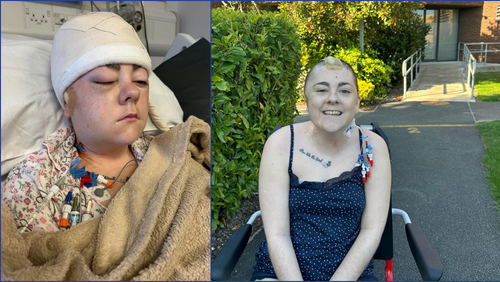
I had a few auras but no seizures for almost six months. For the first time, there was space in my head, quiet where there had always been noise. No one had prepared me for the novelty of a full night’s sleep. However, whether I liked it or not, I had grown into being ‘the epileptic girl’, and without the constant seizures, I wasn’t entirely sure who I was meant to be. Recovery took time and reflection, to remind myself about who I am.
Eight months post-surgery, I managed to get back to work and secure my first job in years! No-one was happier about this than Cillian – as I had been building and planning an endless list of home improvement projects!
My seizures have returned since my surgery – but nothing like before. They are short, manageable, and at least to me infrequent. While I still live with epilepsy, I’m incredibly lucky to be here, writing this, and telling you my story.
As International Epilepsy Day approaches and nearly a year since my surgery journey was shared on The Brain Doctors; I wanted to reflect and share my experience. For anyone living with epilepsy: you’re not alone, and there is hope. Things have improved for me, and I hope they do for you too.
And for those watching from the outside, your willingness to learn matters more than you might realise. Even understanding how to help during a seizure can save a life. After all, it takes a village. Everyone can play a role in supporting those living with epilepsy.
Thank you to everyone who has read my story. I want to close with a thank you that truly matters most to me. To the epilepsy medical teams who have cared for me, guided me, and kept me standing, thank you. You know who you are. I still live with epilepsy, but I’m also here, still myself, still standing (and with slightly less brain than before). I wouldn’t be writing this without you.
Thank you, Katie, for sharing this incredible reflection on your journey as part of International Epilepsy Day 2026. To watch Katie’s surgery journey on the Brain Doctors, see the video below:
Thank you to Katie, Prof Donncha O’Brien and Tyrone productions for sharing this footage with us.
Further Information
- To see and listen to our new campaign for #EpilepsyDay 2026, visit the 'International Epilepsy Day 2026' page on our website
- To learn more about Epilepsy, visit the ‘Epilepsy Information’ page on our website.
- For more information epilepsy surgery visit the 'Epilepsy Surgery' page of our website
- Should you need any information or support about your or your loved one's epilepsy, please do not hesitate to contact your local Community Resource Officer. You can find their details by visiting the ‘Our Local Service’ page on our website.