We would like to advise those living with a diagnosis of Foetal Valproate Spectrum Disorder (FVSD); those who are progressing through the diagnostic pathway; and family members of those with FVSD; that the deadline for registering your interest in participating in the Sodium Valproate inquiry is approaching.
The deadline to apply to participate in the Inquiry is 31st August 2026 and if you are interested in sharing your experiences with the inquiry, you can register your interest by visiting the Contact Us section of the Sodium Valproate Inquiry website.
As many our supporters will be aware, the establishment of the inquiry is something that was jointly campaigned for by Epilepsy Ireland and our colleagues in OACS Ireland (the representatives of families affected) for many years.
While Sodium Valproate (Epilim) is a highly effective anti-seizure medication, if a woman becomes pregnant while taking Epilim, their baby is at risk of serious birth defects and developmental disorders. In 30-40% of cases where the child has been exposed to valproate in utero, the child will have serious developmental disorders. In 10% of cases, the child will have congenital malformations. The HSE estimate that up to 1,250 families have been impacted in these ways by exposure to valproate in pregnancy since the 1970s. This range of conditions and disabilities is known as Foetal Valproate Spectrum Disorder (FSVD).
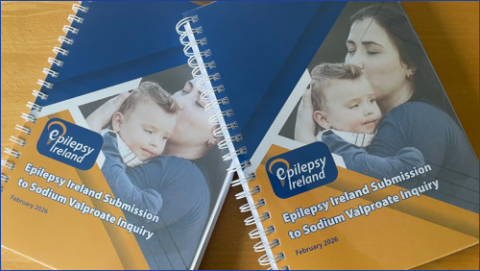
Epilepsy Ireland have engaged directly with the inquiry this year – first making a written submission and then addressing the inquiry as part of the oral hearings phase of its work. In both our written and oral submissions, we highlighted the need for greater resourcing for epilepsy services and the adoption of state-wide registries to ensure the valproate experience never happens again in the future. We also highlighted the need for families affected by Sodium Valproate to be given all the necessary supports required to continue caring for children who have significant disabilities because of their exposure to Sodium Valproate in-utero.
We look forward to continuing to engage with the inquiry as it continues its important work. We hope that when it completes its work, it will deliver for both families affected and future generations of women with epilepsy.
We will provide further updates on the work of the inquiry as they become available on our website and social media channels.
In the meantime, if you need any information or support on your or your loved one’s journey with epilepsy, please do not hesitate to contact your local Community Resource Officer. Visit the ‘Our Local Service’ page on our website for their details.
Further Information
PLEASE CONTACT YOUR HEALTHCARE TEAM IF YOU HAVE ANY CONCERNS. DO NOT STOP TAKING VALPROATE WITHOUT FIRST SPEAKING WITH YOUR PRESCRIBER.
- If you are hearing about Sodium Valproate for the first time and suspect your child may be affected, we would encourage you to talk to our colleagues in OACS Ireland, as representatives of families who have been affected. You can find out more and get in touch by visiting the ‘OACS Ireland website.
- Further information on how to enter the diagnostic pathway for FVSD has also been provided below:
- Under 16 years of age
If a child needs to be referred for a potential diagnosis and they are under 16 years of age, a referral can be made to CHI at Crumlin from their GP or a Consultant Paediatrician (as appropriate). This referral is sent to the Department of Paediatrics in CHI at Crumlin. Once the referral is received it will be clinically triaged by the Consultant Paediatrician, and where appropriate an appointment will be arranged to attend outpatients. At this appointment there may be a decision to carry out blood tests. Where necessary a referral may then be sent to a Consultant Geneticist in the Department of Clinical Genetics. - 16 year of age and over
For patients and clients who are 16 years and older, a referral should be sent from their GP or a Consultant (as appropriate) to the Department of Clinical Genetics, in CHI Crumlin. This referral will be triaged by the Consultant Geneticist, and where appropriate an appointment will be arranged. An assessment will be carried out and relevant blood tests taken for DNA analysis (genetic tests). Genetic tests are sent abroad and depending on the type of test they can take from 6 weeks to a number of months to be tested. Once the results are received, they will be reviewed by the Consultant Geneticist, and the patient's case will be reviewed at a multidisciplinary team meeting to determine the diagnosis.
- Under 16 years of age
- For more information on the risk reduction measures currently associated with Sodium Valproate for women and girls of childbearing age, visit the 'Women' section of our website
- To look back on the history of this campaign alongside OACS Ireland, visit the 'Advocacy' section of our website
- To learn more about this inquiry, visit the ‘Sodium Valproate Inquiry’ website.